
Now Reading: The Ever-Widening Sargasso Sea
-
01
The Ever-Widening Sargasso Sea



If you’ve sailed anywhere in the Caribbean in the last 12 years you’ve seen this stuff floating on the surface of our sea. Gold, yellow, deep ocre red – there is a certain beauty to its colours, at least. But since 2011 the macro algae known as sargassum seaweed has caused real havoc – fouled props, rudders and water intakes on boats; noxious stenches, health issues and massive economic impacts on land; and increasingly frequent damage to inshore ecosystems.


Hey, it’s not all bad. There is plenty that’s great about sargassum. For one thing, it’s supposed to be there. Just not here. Christopher Columbus himself sailed (with some difficulty) through the area ever since known as the Sargasso Sea, northeast of Bermuda, in the lower quadrants of the Atlantic’s Bermuda High, a shifting area of high pressure that causes winds and currents to move in a clockwise direction over thousands of miles of open ocean. For millions of years, though, conditions up there have been perfect for the algae to bloom.
There are two species of sargassum, Sargassum fluitans and Sargassum natans, and they both form large rafts that, at sea, function as drifting ecosystems. They’ve been called floating forests because they are so full of life. Small fish, shrimps, and other tiny creatures in the seaweed attract populations of larger fish, which attract larger fish and larger still. Thus, sargassum forms the foundation of thriving, healthy ecologies out in the vast, otherwise empty deserts of the mid-Atlantic ocean.
On top of this, sargassum is known to capture plenty of carbon as it drifts. Like all plants and algae, it photosynthesises – processing sunlight and carbon dioxide to produce glucose, the tool for building cells whose structure contains carbon. In an atmosphere suffering from CO2 overload, much like we love rainforests and mangroves for their carbon capture properties, climate scientists consider this aspect of sargassum a very, very good thing.
So that’s the upside. But from here things go south. A few thousand miles south, in fact, to an area called the Northern Equatorial Recirculation Region (NERR), the space between Africa and Brazil, where in 2011 scientists noticed an extremely large bloom of sargassum blowing with the easterly trade winds towards our islands. That year we experienced our first major inundations of the weed as it drifted onto our shores.
Since then, with occasional lighter years, sargassum formation in the NERR has become an annual event. “A seaweed blob twice the width of the US is heading toward Florida” said a CNN headline in 2023. That gives you an idea of the scale, and the hype, that we’re now talking about.
Mostly, Sarguassum Inundation Events (SIEs), as scientists call them, are a summertime thing, though blooms can happen throughout the year. As to why they are happening, current scientific consensus says that the new blooms relate to three things: high water temperatures (hence the predominantly summer ‘season’), shifting ocean currents due to larger climactic shifts, and ‘different’ water coming into our seas.
The theory is that water flowing into the Atlantic from the big rivers – the Congo and the Niger in Africa; the Amazon and the Orinoco in South America; and even the Mississippi in the Gulf of Mexico – is different to the water that previously flowed in from those same sources. Up those rivers, we humans are doing all sorts of stuff that’s never been done before. Stuff like deforestation, industrial farming, cities, processing plants, oil refining, housing developments, sewerage plants, etc. That ‘different’ water – higher in nutrients and nitrogen, for instance – is now being transported to different places thanks to shifting ocean current patterns. Once there, it meets higher ocean temperatures than ever before. And all of this is perfect for our macro algae to bloom.
So how bad are its effects? Let’s consider humans first. Once that golden weed washes ashore it stops, piles up, and after about 48 hours it begins to rot. Above water, the rot produces toxic gases called hydrogen sulphide and ammonia. The hydrogen sulphide gives off a rotten eggs smell that, according to the US Environmental Protection Agency, affects the upper respiratory system and “causes nausea, headaches, vertigo, confusion, memory loss and neurocognitive impacts”. And ammonia, which smells like urine and dead fish, has powerful corrosive qualities in high concentrations. So it literally hurts to breath.
If you happen to have asthma or other respiratory disorders, it can be dangerous. If you’re pregnant, you’re at a higher risk of preeclampsia, and if none of the above apply, you’re still thinking of moving out because simply being there becomes a deeply unpleasant experience.
Most newsworthy, it seems, has been sargassum’s economic impacts. Tourism businesses large and small are the main drivers of many Caribbean economies, so imagine all those beaches and bays filling up with seaweed every day and night. You may have a multi-million-dollar all-in-one hotel, or a small beach-side restaurant. Either way, if your main attraction is a beach that regularly disappears under toxic, rotting seaweed, you need to move that sargassum quickly, before customers start complaining, writing bad reviews or simply going elsewhere.
You might grab your shovel and start scooping it off the sand, even as more washes in. Realistically, you’ll have to hire a crew, or some machinery, just to make a dent. And this needs to be paid for. No matter what scale your tourism business operates at, you now have a new, essential cost to your business’ budget. Or maybe, you no longer have a business at all.
In 2022 alone, the 15 member CARICOM group of Caribbean states recorded economic losses of US$102m from the effects of Sargassum, with the cost of beach cleaning among its members reaching US$210m. That’s just in 15 Caribbean islands. A 2023 report in the journal Ocean and Coastal Management calculated that in Mexico alone, monthly clean-up costs per kilometre were between US$10,186 and US$100,446.
And it’s not just beaches being affected. Fishermen find their fishing grounds covered in the seaweed. Ferries and boat operators can’t run when whole bays are so thick with it that vessels can’t move. And even tour operators like me have to work around it or shut down for weeks or months.
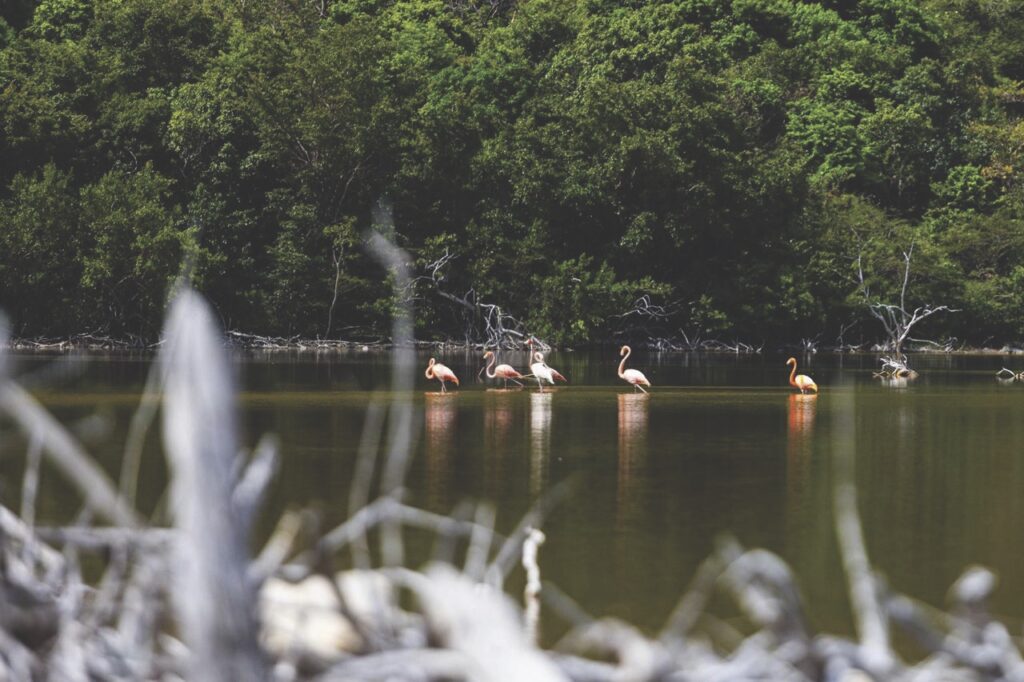
At GroundSea Adventures, our most popular tour is a kayak/SUP paddle through a rarely visited, pristine mangrove lagoon on Beef Island. It’s a magical exploration through a natural wonderland and most years we’ve been lucky with the sargassum events thanks to a barrier reef that protects the mangrove lagoon. But in 2023 we had some funky winds and an enormous SIE hit us. Afterwards, an open-water area of the lagoon looked like solid land, and the thick seaweed penetrated all the way through the forest of mangrove trees.
This is how I learned how devastating sargassum is to inshore ecosystems. At first the raft was simply a cloak of darkness. I dove under and found nocturnal fish swimming around in the daytime, clearly confused. I saw algae, and the magical upside-down jellyfish, both of which live by photosynthesis, weakened due to the lack of light.
But in the days after the initial inundation, when the rot set in, the horror show began. It turns out that the process of rotting needs takes the oxygen from the water. So, when I tried to swim under the huge mat of seaweed on Day 4, I couldn’t, because from the surface to the seafloor, the water had turned into a thick, semi-transparent mucus. Just by looking in I could see the extent of mass death. Hanging, suspended in this thick goo were shrimps, crabs, jellyfish, baby barracuda, snappers and every other species we normally see swimming in the lagoon. They hung at different depths, many of them curled up in death, like a scene in a horror film.
I shut down tours for three months after that because you can’t show people around a dead lagoon.
Thankfully, by the end of November enough had recovered for us to reopen. By the end of January we were seeing the first re-spawned jellyfish and several other species had come back. And by May of 2024, almost all the colour and vibrancy of the lagoon had returned. So much so that I commented on it to a group of guests as we paddled. And guess what – the next day, another SIE came in. Not as large, this time, but enough to shut down business for three more weeks, and a reminder that although nature has miraculous ways of recovering, too many of these events, too often, could do our ecosystems serious permanent damage.
With the scale of this problem, there are some incredible innovative solutions being worked on to solve the sargassum problem. Regional governments are working together on early warning systems to alert each other of impending SIEs; better boom and sargassum diversion systems are being developed to keep it off our shorelines; machinery for removing it from both waterways and beaches is getting more efficient; one Mexican entrepreneur who collects it from hotel beaches is now successfully making building bricks with 40% dried sargassum content; and for sailors, there are clever systems being developed for keeping it off of rudders, out of props and water intakes.
My two favourites, though, are, first, a scheme being worked on by Ajit Subramaniam, a biological oceanographer at the Columbia University. He’s one of the scientists who found the first giant sargassum rafts in 2011. His theory is that by gathering huge amounts of it and sinking it rapidly to depths of about 2000 metres, its large carbon content will be taken out of the system. Subramaniam’s thinks that sinking will help gain us time in the immediate, urgent fight to reduce CO2, and of course doing so reduces the amount heading towards our islands.
The second solution is at a much smaller scale. It’s a worm called pontidrilus discovered by researchers to have a taste for sargassum wherever it accumulates on shorelines. The worm breaks down sargassum, but better than that, pontidrilus also seems to remove the worst toxins from it, and thus potentially transform it into a farm-friendly fertiliser.
Up to now, the easy-sounding solution of using sargassum as a fertiliser has hit a roadblock thanks to numerous heavy metals, like arsenic, that are absorbed into sargassum from the ocean. But a recent study by Caribbean farmers and Cornell University has shown that once the pontidrilus worm has eaten through a mountain of sargassum, its worm castings are actually clear of these heavy metals. Research continues, but the hope is that the clean castings can make a healthy additive to Caribbean farmers’ soil.
We live in the proverbial “interesting times” and for those of us in the Caribbean region, there’s no doubt that our climate and ecological systems are experiencing some shocking changes. Sargassum, along with reef diseases and bleaching events, record water temperatures and record powerful hurricanes, all tell us that something is seriously awry. But human beings are good at adapting, innovating and finding solutions. So while the SIEs continue to worsen and the future looks scary from many angles, I’m holding out hope that we’ll find ways to turn the Caribbean’s golden weed problem into something useful. Maybe it’s a worm, maybe it’s a mass sinking strategy. Either way, it’s good to know that many great minds are working on it.
Related Posts
Previous Post
Next Post