
Now Reading: 5 Ways HLSCC’s Centre for Applied Studies (CAMS) is MAKING WAVES for the BVI’S “NEW” BLUE ECONOMY
-
01
5 Ways HLSCC’s Centre for Applied Studies (CAMS) is MAKING WAVES for the BVI’S “NEW” BLUE ECONOMY

5 Ways HLSCC’s Centre for Applied Studies (CAMS) is MAKING WAVES for the BVI’S “NEW” BLUE ECONOMY

The nations and territories of the Caribbean have traditionally been referred to as “small-island states,” with their minuscule landmasses serving as their defining characteristic. This type of perspective emphasises what small islands lack, overlooking the literal and proverbial surrounding seas of opportunities lapping at their shores. Under international law, the British Virgin Islands has rights and responsibilities to over approximately 84,000 square kilometres of maritime space. This is an ocean area significantly larger than its terrestrial space!
Although the ocean has almost always been ‘everything’ for island dwellers in places like the BVI, the rest of the world is finally catching up. The growing global awareness about the universal importance of the world’s oceans to human well-being has supported the emergence of the “Blue Economy” as a concept that balances economic development with preserving marine ecosystems and biodiversity. This approach emphasises the importance of community engagement, scientific research, and policy coordination to ensure the long-term sustainability of ocean resources. Following this growing trend, the Government of the Virgin Islands launched the “Virgin Islands Strategic Blue Economy Road Map in 2020 with the support of the United Nations Development Programme (UNDP),” which set out an integrated approach to ocean-based sustainable development for the Virgin Islands.
Within the Virgin Islands Blue Economy Strategic Road Map, the H. Lavity Stoutt Community College (HLSCC) and its Centre for Applied Marine Studies (CAMS) are recognised for their potential role in supporting the sustainable development of the maritime tourism sector, improving the existing knowledge base about the marine environment, and strengthening the capacity to undertake future research. Here’s a closer look at how CAMS works to support the developing “Blue Economy” in the BVI.


#1 Helping to Increase the number of young people pursuing Maritime Sector Careers
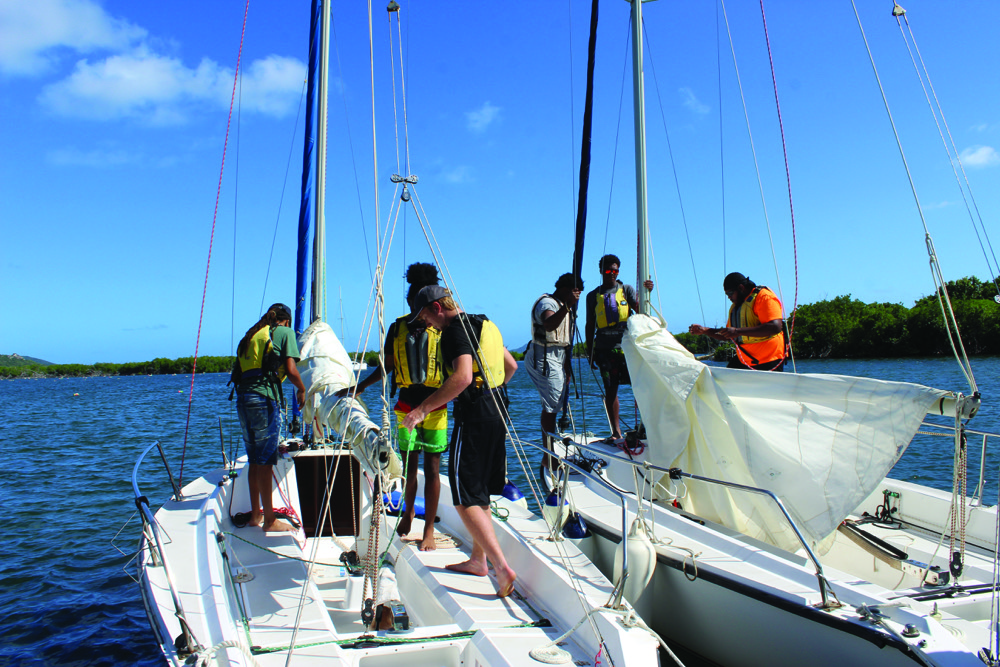
Developed in 2019, HLSCC’s Marine Professional Training (MPT) Programme is a gateway programme for young persons to pursue vocational training in the maritime sector. The programme supports intensive workshop learning at the Centre of Applied Marine Studies (CAMS), where students earn globally recognised certificates or engage in curricula developed by international partners such as the Royal Yachting Association (RYA), the American Sailing Association (ASA), the UK Maritime Coastguard Agency (MCA) and the American Boat and Yacht Council (ABYC). Following workshop learning, students are paired with marine industry partners and engage in short apprenticeships that expose them to maritime career opportunities.
#2 Working with the Private Sector to develop Maritime Sector Capacity
Recent partnerships between the College and the private sector have led to developing the “Beyond Curriculum Tech Workshop Series” with Nanny Cay and Marine Max Vacations. Since 2023, this initiative has facilitated more than a dozen workshops taught by international dealers. Some topics covered in the workshops include the service, repair and maintenance of marine generators, diesel engines, outboard engines, and watermakers. Costs of running the workshops are offset by Marine Max Vacations and passed onto the public so that persons working in the industry have a convenient, affordable opportunity to improve their technical skills without leaving the British Virgin Islands.
#3 Build a portfolio of locally sourced solutions to marine environment challenges being faced in the BVI
Hurricanes Irma and Maria wreaked havoc on the British Virgin Islands in 2017. In addition to massive infrastructure damage, the BVI lost 90% of its mature red mangrove trees. Mangroves are specially adapted, salt-tolerant trees that grow on and along the coast. Mangroves play a critical role in protecting coastal communities during severe storms by offsetting wind and wave action. In 2020, CAMS launched its Mangrove Nursery and Coastal Resilience Laboratory. The mangrove nursery facility can produce about 2,000 mangrove seedlings annually, used in plantings across the Territory, led by a small team of recent HLSCC graduates and current students. Since its inception, the nursery has planted thousands of mangrove seedlings with hundreds of visitors from dozens of community-based organisations, environmental agencies and schools in the BVI.
#4 Improving Public Awareness of the Broad Role that Oceans and Coastal Environments Play in the Economy & Society
Regardless of their chosen career path, improving environmental literacy among young people will be a key driver for the BVI’s Blue Economy. In 2023, CAMS launched marine biodiversity and coastal resilience components of the “BVI Smart Schools Project,” a joint initiative of various BVI agencies (BVI Department of Disaster Management, the BVI Red Cross, and Green VI) which aims to improve the resilience of the BVI’s primary and secondary schools, including their teachers and students. Over the last year, CAMS has hosted experiential field trips for nearly 350 primary and secondary school students, focusing on coastal resilience and marine bio-diversity. Students explore coastal habitats firsthand, and CAMS educators reinforce core science concepts students learn in their classrooms. CAMS has also been working to integrate ocean literacy and environmental awareness into a “Blue Economy” module delivered to its Marine Professional Training (MPT) students, reinforcing the important tie between environment and industry.
#5 Developing systems to build information about how human actions impact our marine and coastal ecosystems
The Centre for Applied Marine Studies (CAMS) houses three laboratories. Via a network of partners, such as the BVI Department of Disaster Management, the Ministry of Environment, Natural Resources and Climate, and the Unite BVI Foundation, CAMS has been working to upgrade outdated equipment and support improvements in territorial environmental monitoring, especially for water and soil services. Since 2022, the CAMS analytic lab has supported the analysis of soil samples collected by the BVI Department of Disaster Management to create soil layer maps for the BVI. Soil analysis is also being integrated into CAMS’s ongoing coastal restoration work. Similarly, the analytic lab provides laboratory space for the Government of the Virgin Islands’ Beach Management programme. Water samples collected from BVI coastal areas are analysed at the CAMS laboratory. Plans organized by the Ministry of Environment, Natural Resources & Climate Change and are currently underway to increase and improve Territorial water monitoring
About the Centre for Applied Marine Studies
Located in Paraquita Bay, Tortola, the H. Lavity Stoutt Community College (HLSCC) is the British Virgin Islands’ only tertiary education institution. The Centre for Applied Marine Studies (CAMS) is a 17,000-square-foot facility occupying the Southern Campus of HLSCC’s Paraquita Bay location The facility was built in 2004 with the intended purpose of becoming a regional centre of excellence for maritime training for the Eastern Caribbean. The facility boasts classrooms, technical workshops (woodworking, composite boat repair, marine propulsion), marine science laboratories, a maritime fire training area, a mangrove nursery, a 1,200-foot-long boardwalk that winds through the Paraquita Bay mangroves, and a small working waterfront with a small boat launch and two small docks.
Related Posts

Previous Post
Next Post