

Now Reading: A Life Through the Lens: Jim Scheiner’s 50-Year Journey Beneath the Surface
-
01
A Life Through the Lens: Jim Scheiner’s 50-Year Journey Beneath the Surface


A Life Through the Lens: Jim Scheiner’s 50-Year Journey Beneath the Surface

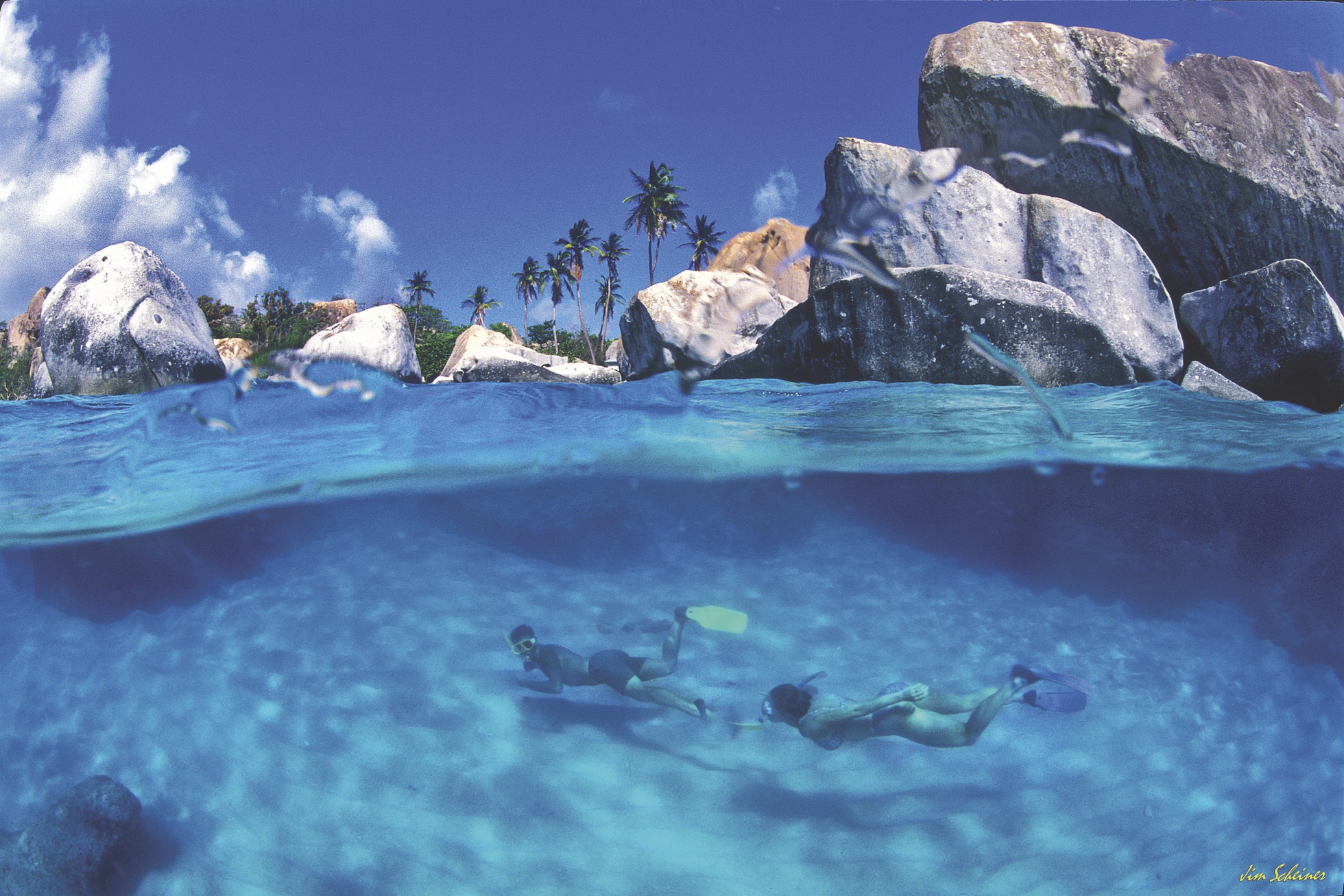
It was a hot and humid afternoon on Tortola, the kind that makes the sea shimmer like glass and slows time to a gentle crawl. I sat with Jim Scheiner on his porch, the soft rustle of palm fronds in the distance and the occasional flutter of wings overhead. The rhythm of island life played quietly in the background—familiar, unhurried, content.
Every so often, his wife Sybil would appear in the doorway, offering a glass of something cold and checking in with a smile. Her presence was soft and grounding—a beautiful part of the scene, like a verse in a favourite song.

Jim Scheiner
At 70, Jim Scheiner isn’t just reflecting on a lifetime of images he is curating a legacy. In their modest home on the hill, he is surrounded by an extraordinary catalogue of visual history: thousands of slides from the 1970s and 1980s, stacks of negatives stored meticulously in sleeves, boxes filled with prints, digital files, and notebooks scribbled with dates, dive sites, and moments frozen in time. It is not just a collection it is a living, breathing archive of Caribbean life, underwater worlds, and global adventures that span nearly every corner of the diving map.
Jim Scheiner’s journey began in suburban New York City. By the age of 16, he was already diving, discovering early the underwater world that would shape his future. In 1975, at just 20 years old, he became a certified PADI SCUBA Instructor. He has just celebrated 50 years of teaching others how to explore the world beneath the surface.
His first job in the Caribbean came even earlier, in 1972, when he worked in Grenada at the age of 17. After graduating high school in 1973, he returned to the island before continuing his studies at the University of Pennsylvania. College did not keep him away from the region for long he spent his student years diving and working in the Dominican Republic and Haiti, followed by a stint in St Thomas in 1978.
Then came the turning point. In 1979, at just 24 years old, Jim arrived in the British Virgin Islands. What began as a job as a dive instructor and guide at Aquatic Centres at Prospect Reef became a permanent home. “I never left,” he said simply, his eyes crinkling with a smile. He spent the next five years introducing tourists to the magic of the BVI’s underwater world before venturing deeper literally and creatively.
During the 1980s and 1990s, Jim also led expeditions to some of the world’s most remote and pristine dive sites. From the Galápagos to Papua New Guinea, from the Red Sea to the Great Barrier Reef, from Truk Lagoon to Palau, and even among the great white sharks of Baja California, he captured marine life and human experience with rare intimacy. His adventures also included diving in British Columbia, Ireland, Thailand, the Solomon Islands, the Coral Sea, and with whale sharks in Western Australia.
He documented humpbacks in the Silver Banks and served as a production assistant and dive crew member on early dive documentaries for major networks. Jim was a regular contributor to dive publications and travel magazines and authored the Dive Guide to the British Virgin Islands in the 1990s.
Yet for all his global travels and accolades, Jim never strayed far from the islands he called home. The BVI remained his muse a place of colour, culture, contrast, and calm. His lens captured it all.
In the early 2000s, he fully transitioned from film to digital, continuing to evolve as a photographer. His work became increasingly focused on corporate and lifestyle photography, but he always returned to the sea. “Photography is about presence,” he told me, glancing toward the ocean. “It’s about really seeing what’s in front of you. Not just the subject, but the feeling.”


Photography was never far behind. After a transformative year sailing on a 47-foot Olympic yacht named Tinkertoy with his future wife Odile, who passed in 2006, as captain, Jim’s creativity found new purpose. In 1986, the two launched Rainbow Visions, an underwater photo and video business. Their small storefront at Prospect Reef became the BVI’s go to place for professional diving photography, custom Rhone dive videos, and instructional classes.
What started underwater expanded above it. By the 2000s, Jim transitioned fully to digital photography. His portfolio exploded. Rainbow Visions became known not just for dive photography but for weddings, events, corporate brochures, headshots, aerial shoots, fashion, real estate, incentive group photography, and more. He worked with both international magazines and local businesses, writing and photographing pieces for dive publications and tourism outlets.
In those early days, Jim wasn’t chasing fame. He was chasing light, texture, authenticity. “Photography is about presence,” he said, glancing toward the horizon. “You can’t fake your way through it. You have to see what’s really there.”
Now retired, Jim is focused on a new kind of work curating. His vast archive of 20th century slides, negatives, and digital files spans five decades of Caribbean history, adventure travel, and quiet island life. He is currently digitizing his collection and organizing his BVI library of images, both analog and digital. He is also working on a coffee table book, a long-awaited tribute to the islands that have inspired and embraced him for nearly half a century.
As the afternoon light softened and the breeze picked up, Jim leaned back in his chair. There was no need to rush. Around him, the sounds of the island carried on distant laughter, the occasional squawk of a bird, the sea moving in its endless rhythm. It was easy to imagine that same tranquility running through every photograph he has taken, every reef he has explored, every frame he has shot.
In an age where so much is disposable, Jim Scheiner’s work stands apart not just because of its technical brilliance, but because of the heart behind it. His lens has always been guided by curiosity, respect, and wonder. And as he gently shapes the legacy of a life in images, he reminds us that beauty is everywhere if you know how to look.

Related Posts
Previous Post
Next Post